

A Venetian mirror is prized for their hand-worked details, luminous glass, and the centuries-old Venetian tradition behind them. Yet, unfortunately terms such as “Venetian mirror,” and “Venetian-style,” are often used loosely online and by retailers around the world—sometimes to describe mirrors with no genuine connection to Venice or the true Murano craftsmanship.
This article explains what authenticity looks so you can evaluate listings, ask the right questions, and purchase through vetted sellers with confidence.
What makes a Venetian Mirror Different from a Murano Glass Mirror?
Venetian-style mirror: may be produced anywhere; the design language is Venetian, but materials and workmanship vary widely.
Murano glass mirror: Authentic Murano glass may be sold anywhere in the world, but it must be created on the island of Murano—not simply elsewhere in Venice. Its decorative glass elements are handcrafted by Murano artisans, often through traditional lampworking or molding techniques, before being meticulously finished and assembled.
-
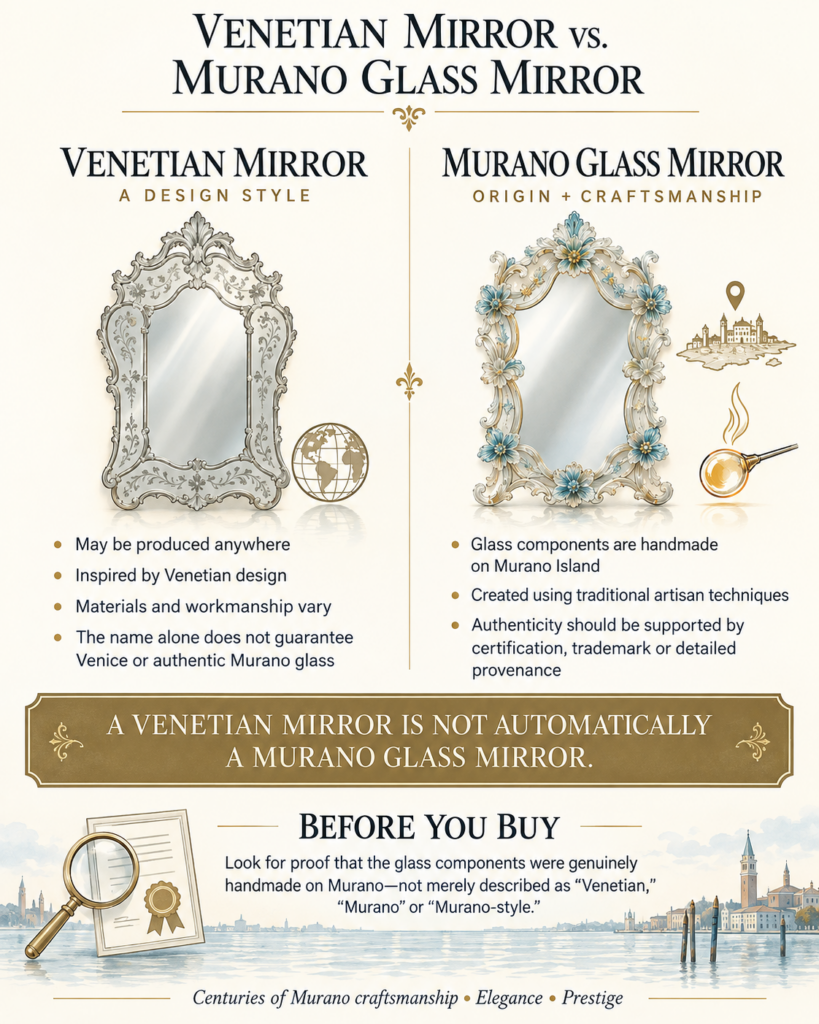
A Venetian mirror may reflect the traditional Venetian style, but that does not mean it was made with authentic Murano glass.
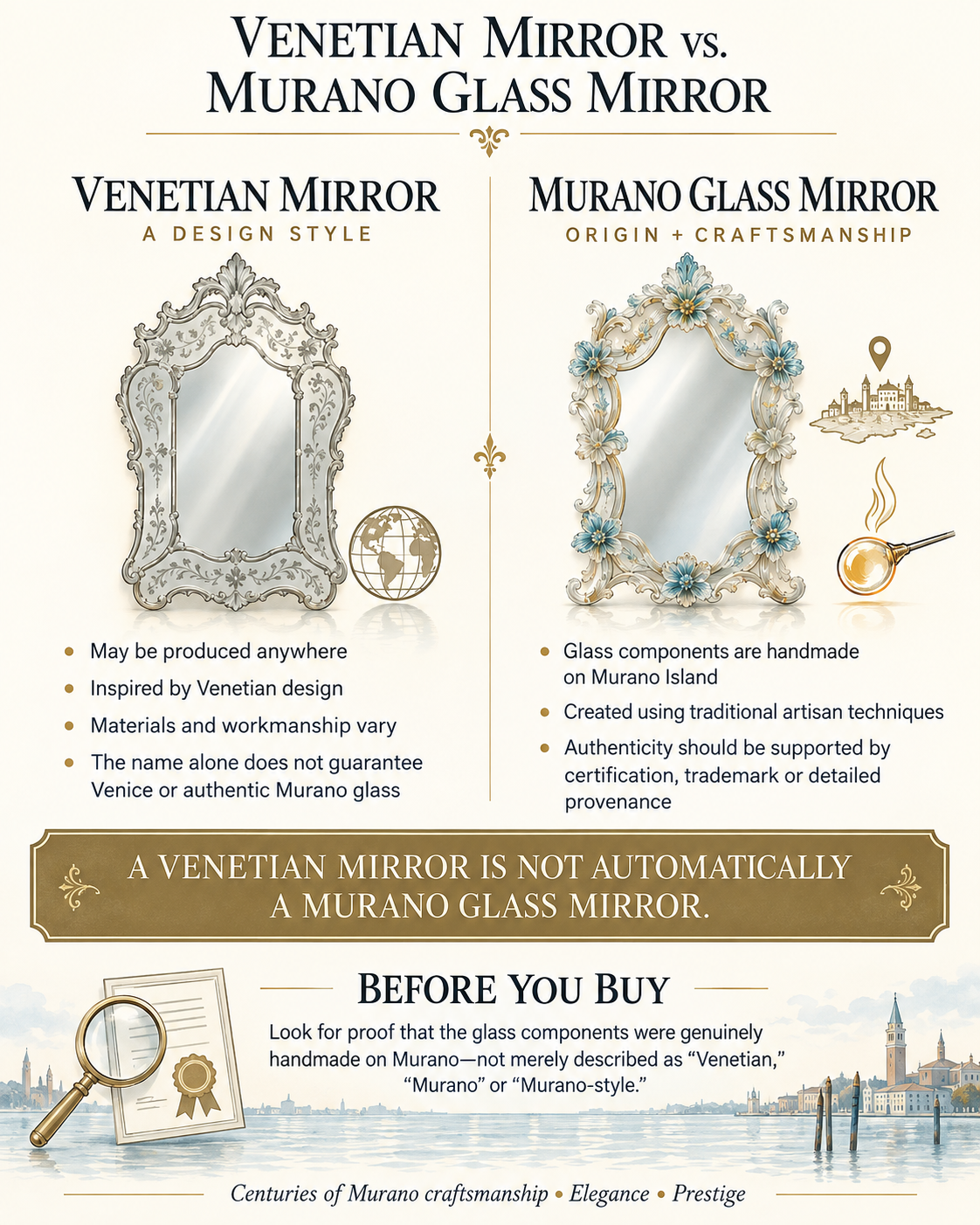
The distinction is important: “Venetian” can describe a style, while “Murano” identifies the origin of the glasswork. Many mirrors reproduce the Venetian aesthetic, but far fewer are made with authentic Murano glasswork and supported by credible documentation.
In short, a Venetian mirror is not automatically a Murano glass mirror. If you are seeking a truly authentic mirror that embodies Venice’s celebrated glassmaking heritage, it must feature genuine Murano glass handcrafted on the island of Murano. The word Venetian may describe an ornate style, but it does not guarantee origin, artistry or authenticity. A Murano glass mirror, supported by recognized certification, a trademark or detailed provenance, offers something far more meaningful: a work of art shaped by centuries of tradition and the skilled hands of Murano’s master glassmakers.
Authenticity: What to Look For
Use the checklist below to assess a product page or to guide your questions to a seller. No single point is definitive on its own; the strongest signal is a consistent set of details that align with artisan production.
- Clear origin statement: The listing should specify that the glass elements are made in Murano, Venice (not merely “Venetian,” “Venetian glass,” “Venetian mirror,”or “Murano style”).
- Documentation: Reputable partners can provide a certificate or provenance statement and will explain who issues it.
- Handmade variation: Expect subtle differences in rosettes, flowers, or scrollwork—perfect uniformity can indicate mass production. Each piece will have some differences.
- Construction details: Ask how the mirror is assembled (mounting method, backing, hardware) and where final assembly occurs.
- Close-up photos: Look for crisp edges, clean joins, and depth in the glass; request macro images of decorative pieces.
- Transparent pricing: Authentic artisan work is labor-intensive; unusually low pricing is a red flag. It will be expensive.
Baroque vs Modern Murano Mirror: Choosing the Right Style
Murano mirrors range from richly ornamented Baroque silhouettes to modern, architectural frames with restrained glass accents. Your choice should be guided by room scale, wall space, and the role the mirror will play—a statement piece or subtle refinement.
- Baroque Murano mirror: Best for entry halls, dining rooms, and formal living spaces; pairs well with antiques and layered textures.
- Modern Murano mirror: Ideal for contemporary interiors; emphasizes proportion, negative space, and refined detailing.
- Large Murano mirror: Anchors a room; confirm weight, mounting requirements, and delivery logistics before purchase.

Questions to Ask Before You Buy
When you’re ready to purchase, send these questions to the seller. A trustworthy partner will answer clearly and provide supporting photos or documentation.
Where are the glass elements produced—Murano, Venice? Where is the mirror assembled?
Can you provide a certificate or provenance statement, and who issues it?
Are the decorative components handmade? Can you share close-up images of the rosettes/flowers and joints?
What are the exact dimensions, weight, and mounting hardware included?
What is the lead time (in-stock vs made-to-order) and return policy for custom pieces?
Don’t Settle for Venetian Style Mirror —Choose an Authentic Murano Glass Mirror
We curate authentic Murano glass mirrors from Venice and direct you to vetted partner sellers to complete your purchase securely. Our articles and store focus on authenticity signals, clear buying steps, and practical details—so you can choose a mirror that is both beautiful and verifiably made. When you’re ready to explore curated options, the next step is simple.